Delaware Riverkeeper sues DRBC over Gibbstown LNG port permit extension
| November 4, 2025

For our complete coverage of the Wyalusing, Pa./ Gibbstown, N.J. LNG project, please click here.
An environmental group has gone to federal court to block a permit extension granted to the developers of a controversial port on the Delaware River in Gibbstown, N.J., that would serve as an export site for liquified natural gas.
The group, the Delaware Riverkeeper Network, brought the legal challenge in the United States District Court for the District of New Jersey last month against the Delaware River Basin Commission. The Riverkeeper maintains that the commission in September wrongly granted a second extension of five years for the construction of the project.
The legal challenge is the latest turn in a proposal with many moving parts that has been in the works for at least six years and shows no signs of a quick resolution.
Permit called for dredging
The DRBC extended the permit for the dredging and the construction of a deep-water berth at what is known as the Gibbstown Logistics Center Dock 2 at a multi-use marine terminal. The site would be used to load bulk liquid products, such as LNG, liquified petroleum gas and other products, directly from railcars or trucks onto ocean-going vessels for export via the Delaware River.
That berth was one part of a larger, more intricate plan that originally called for taking fracked natural gas via pipelines from the Marcellus shale region of Pennsylvania to a plant in Wyalusing, Pa. The plant would liquefy the gas and send it by trucks and/or rail tankers to the Gibbstown port.
The $800 million project was projected to have an average daily production capacity of 3.6 million gallons.
However, in the intervening years, the ability to transport LNG by rail has been erased through court rulings and federal rule-making, and the developers have shifted their plans for the Wyalusing site. As a result, the project faces an unclear future.
Tanker trucks on highways, not rail cars, would be the answer
Nevertheless, the backers of the project, Delaware River Partners, have sought to move ahead with the development of the Gibbstown port, arguing, according to court papers, that LNG could still be moved there via tanker trucks.
The Delaware River Partners, an affiliate of the energy giant New Fortress Energy, calculated that approximately 218,182 trucks would be needed to travel from Wyalusing to Gibbstown each day to export the average daily volume of LNG authorized by the federal Department of Energy for export from the port, the Riverkeeper lawsuit said, citing a figure presented to the Federal Energy Regulatory Commission.
Five years ago, the developers estimated there would be as many as 400 trucks making the trip but that was at a time when LNG-by-rail was still in the equation.
Critics have warned of the potential failure of an MC-338 cryogenic highway tanker. If an LNG tanker were breached and a vapor cloud ignited, an explosion could send projectiles hundreds of feet as well as set off a fire that can burn as high as 2,426 degrees – more than twice the flame temperature of gasoline.
And at the site of the port itself, the Delaware Riverkeeper Network said it is surrounded by densely populated communities, including in Paulsboro, N.J., and across the river in Pennsylvania, whose safety would be jeopardized.
“The site is made up of vast wetlands and is connected to the vulnerable ecosystems and habitats of the Delaware River,” the network said in a statement. “The Dock 2 LNG wharf would have required dredging and river construction that would destroy irreplaceable habitat for the federally endangered Atlantic Sturgeon and other keystone marine life, including rare aquatic vegetation, and would stir up PCBs and other toxic pollutants that are now buried in the river.”
The heart of the lawsuit
The Riverkeeper contends that the developers had already been granted one permit extension and that DRBC’s rules do not allow for a second extension. Further, the suit asserts that the project has substantially changed, and therefore would be disqualified from being eligible for an extension.
Among the changes the Riverkeeper cited was the loss of a critical federal permit to transport LNG by rail. Further, the proposed LNG processing plant in Wyalusing is instead being retooled by New Fortress Energy under the name Klondike Digital Infrastructure to become a power facility and data center.
A representative for Delaware River Partners could not be reached. As of Tuesday, the DRBC had not filed a response to the lawsuit, which was filed on Oct. 10. A spokeswoman for the DRBC declined comment, citing the pending litigation.
However, records on the commission’s website said the agency’s rules contain no language limiting approvals to a single extension; that it amended its rules effective in July 2024 regarding the conditions under which a permit may be extended; and that the developers had met the criteria needed to be granted such an extension.
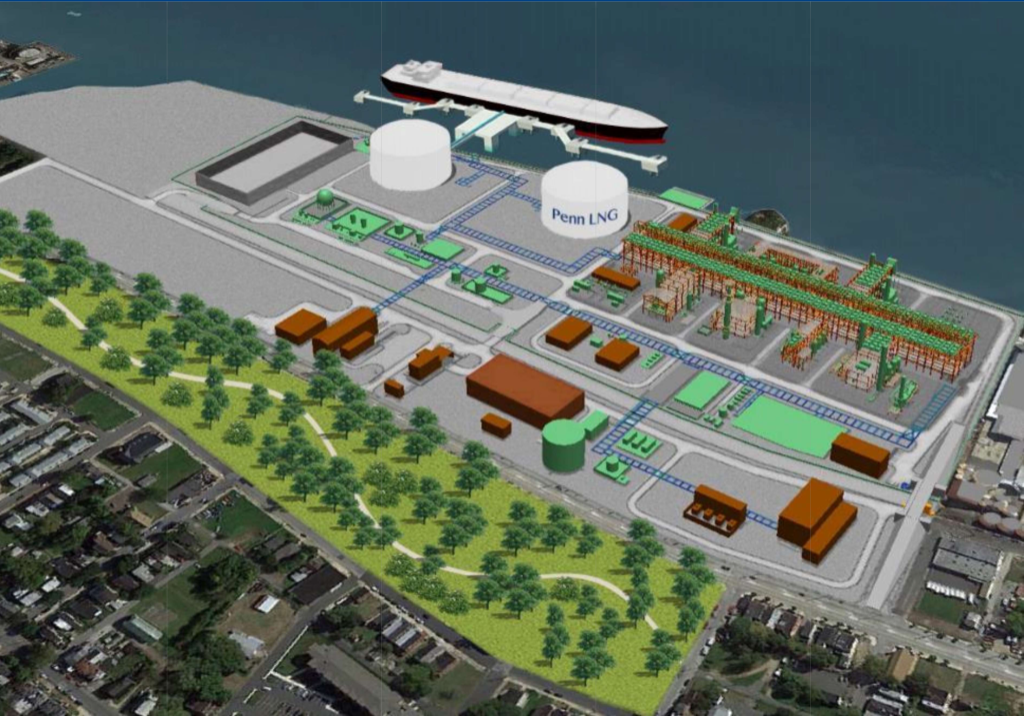
A Pennsylvania House committee will host a hearing on Wednesday about an unrelated project but one that also proposes to export LNG via the Delaware River. The House Environmental and Natural Resource Protection Committee will host the hearing at 10 a.m. at Chester City Hall, in Chester, Pa., about a plan by Penn America to build an LNG export terminal in Chester or adjacent locations in southeastern Pennsylvania on the Delaware River. The hearing will be streamed via the committee’s website.

Recent Stories