

To Know A Watershed, Explore A Creek
| December 22, 2025
I’m cruising around an affluent neighborhood in rural New Jersey. I look suspicious, like I’m casing out houses — which I actually am. I’m trying to find a particular property. An hour earlier, I’d studied it online. I’d zoomed in on its backyard woodland, tracing what looked like a subtle groove through the trees. Now I’m trying to see those trees from the road. But I can’t even find the house. The lots are too big, their gateways too shielded by shrubbery. If this is where the Assunpink Creek starts — as hydrological maps suggest — then I’m not going to find it.
I’m looking for the source of the Assunpink Creek because until today, all I know of this waterway is its reputation as an urban stream. I’ve seen the last few miles flow through Trenton, New Jersey’s capital, and watched it skim between row-homes as dense as teeth. As a city river, the Assunpink is an underdog. It’s constrained by concrete and riprap and it vanishes in places — all clues that it’s a footnote to metropolitan life.
I feel sorry for it.
Yet this 23-mile-long creek starts in Monmouth County, a spacious rural pocket of central New Jersey. That place is as noted for its farms and woodlands as it is for its politically conservative bent. I’m surprised a short creek can so dramatically change character from source to mouth. I want to see how.
It’s not just because I’m curious.
The Assunpink Creek is a tributary of the Delaware River. Like many of the 2,000 streams feeding this waterway, the story of one creek could apply to any number of Delaware River creeks. After all, no matter where communities are, they tend to bend the course of their local streams, or shepherd them into dams to control their pace. In turn, those rivers are asked to soak up the byproducts of our ways of life. To understand a complex system such as the Delaware River watershed then, it’s worth knowing something of its component parts. One might start by exploring a humble creek.
The rural creek
It’s the first freezing day of fall and the trees of Monmouth County are almost bare. As I pass horse stables and faded Trump flags, leaves rain down like confetti.
I’m at the spot where street maps first acknowledge the creek — some 2,000 feet northwest of that property I’d been scoping earlier. Assunpink is the Lenape people’s term for watery place. I want to see the official moment when this watery place begins. However, there’s a man behind me in a white Chevrolet. He’s been tailgating me for miles, and as I slow for the culvert on Rising Sun Tavern Road, he leans on his horn. In my rearview mirror, I see his red face paired with the golden fur of the dog beside him. They’re straining toward the windshield as if to signal haste. I pull over next to a barn and the guy and his dog speed past, a whiff of unwelcome in their wake.
-

I double back to the culvert and park on the verge. There’s a corrugated steel pipe poking from a mud bank and it’s dipping into a pool, inky and still. Hello, Assunpink Creek. The water passes under the road and onward into another woodland before carving into the distance between a stand of trees.
If I were the creek, I’d be pleased about where I was headed. It is now in the Assunpink Wildlife Management Area, a protected zone set aside for habitat conservation. The land is owned by the New Jersey Department of Environmental Protection and managed by NJ Fish and Wildlife. It’s paid for by fees from hunting and fishing licenses, among other sources. The Assunpink WMA, which covers more than 6,000 acres, is advertised as one of the best birdwatching areas in central New Jersey. It also contains several lakes — created when flood-control dams were built in the 1960s — now a boon for anglers.
I follow the Assunpink Creek to its arrival at Rising Sun Lake. There’s a boat launch and a dock, but there’ll be no recreation today. The wind is whipping the iron surface of this lake into white caps.
As I head back to my car, I spot a notice for a public meeting pinned to a board. It’s about the Assunpink Watershed Plan. I learn later that state agencies must upgrade five dams in the Assunpink Watershed because, despite being only halfway through their design life, they can no longer keep up with changing rainfall patterns. The dams, including the one I’m at now, are no longer considered safe. Costing millions each to fix, they signal climate change’s exorbitant toll. As I wonder who might turn up for this public meeting, I hear gunshots in the distance.
-

It’s an eight-minute drive through the WMA from Rising Sun Lake to Assunpink Lake, another of the dams slated for a safety upgrade. When I round a bend, I see a man wearing a bright orange jacket. In one hand he holds a rifle, in the other the collar of a leaping hound. By the time I reach Assunpink Lake, I’ve lost count of how many men in hunting orange I’ve seen. I learn later that this WMA is stocked with pheasant in the fall.
Today Assunpink Lake is even less inviting than my previous stop. A brisk wind is now carrying snow flurries, which slash my face as I walk toward a noticeboard. I’m braving the elements because I see a familiar orange sign. It’s a warning that a potentially harmful algal bloom — a HAB — had been detected. Lake users were advised not to swim, eat from, or allow their dogs to play in this lake. The notice is not dated, but I learn later this bloom appeared in July 2025.
HABs are a growing problem for American waterbodies. These explosions of algal organisms can suddenly appear, taking on the look of pea soup or a slick of green paint. Each bloom is different, depending on the factors that caused it, but some can be toxic when consumed.
Water managers take HABs seriously, but they are only getting worse. Since New Jersey began tracking them in 2017, confirmed cases have increased by 111 percent. Yet HAB prevention is hard. Their core accelerants are heat, sunlight, and nutrients — particularly nitrogen and phosphorus. These elements enter the water as runoff from multiple points, including wastewater treatment plants, septic systems, and suburban lawns, as well as from the animal manure and chemical fertilizers that wash off farmlands. Many communities within the Assunpink Creek watershed could be fueling these toxic blooms.
On my way out of the WMA, the Assunpink Creek crosses picturesque farmlands. From the road, I trace the creek by following ribbons of riparian trees. I pass neon-green fields, suggesting newly planted cover crops. Others are the burnt umber of a recent harvest. At one farm, a combine harvester lies idle next to piles of wheat kernels, while flocks of birds rise from the stubble on adjacent land. As I point my car toward the New Jersey Turnpike, the word folkways comes to mind.
The suburban creek
The New Jersey Turnpike is on my right. I can’t see it, but when I open my window, I hear traffic just beyond the tree-line. It sounds like a tornado wind. On my left I pass one housing development after the other, followed by a large tract of empty land. “Dreams Pending,” a realtor’s sign says.
I know the creek is about to bend toward the Turnpike and then flow toward suburban New Jersey. I feel nervous for it, but I needn’t be. The creek’s passage under the freeway is surprisingly pretty. It’s accompanied by wild grass and riverine vegetation all the way into a broad culvert that dips beneath the Turnpike and emerges blithely on the other side.
In Robbinsville, there are more people around. Landscapers and home contractors circle large stone-clad houses. The local Wawa is doing brisk business, and I drive past several schools and playgrounds before pulling into a lacrosse field, which neighbors the creek. I don’t see the water but I do see the woodland it passes through. There are walking trails cutting through the trees. On sunny days I imagine families traipsing the banks of the Assunpink, their minds consumed not with the adventures of this creek, but with their own tales of suburban life.
-

Near Quakerbridge Road in Lawrence Township, I’ve entered strip mall-land. Just over the bend is that emporium of mass consumption: a Costco Wholesale warehouse. I park outside a fast-food joint and slide down an embankment toward the Assunpink Creek. It emerges from beneath a road so busy that the cars passing above are a single streak of steel. Yet the creek itself is calm. A large storm pipe on my left points toward the stream. It’s dry today, but as I drive away, I see the fields of asphalt that will soon collect gallons of runoff and send it down that pipe. I merge with traffic just as a flock of starlings rise and blot the sky.
I’m now following the creek as it flows toward Trenton. I crisscross roads as best I can, passing a Hindu temple, a self-storage facility and a fire-fighting training center. I wonder whether any forever chemicals washed into the Assunpink Creek from the centers’ possibly PFAS-laden firefighting foam. But before I have a chance to think about toxins, I’m back alongside the creek as it passes through woodland. A flash of water sparkles between the trees, and then it’s gone. The Assunpink is now running alongside the Delaware and Raritan Canal, which means it briefly shares a protected green space inside the Delaware and Raritan State Park, New Jersey’s longest linear park. I’ve spent so long tracking this little waterway today. I feel unaccountably happy to find it here.
The urban creek
It looks like the film set for a disaster movie. The block-sized lot ahead of me is piled high with debris, and my eyes widen as I examine twisted metal, mounds of rubble, and scores of shattered planks. It’s as if a hundred homes exploded. The pile is backlit by the burnt-out hull of an old building, whose blackened facades and crumbling towers loom over the site. A rusted water tower caps the scene. Its steampunk meets Godzilla.
I’m at the crossroads of Whitehead Road and Sweet Briar Road. The Ewing-Lawrence Sewerage Authority is behind me and the creek has just passed through Whitehead Pond Dam. The creek recently flowed over a rocky stream bed, making it rush and gurgle like a model for a healthy stream. But as it passes beneath Whitehead Road, its prospects dim.
-

I learn later that the site I’m looking at had been the Goodall Rubber Mill. Built in 1870, it was the oldest rubber factory site in the United States, until it burned down in 2023. The owner at the time — Hakim International Trading & Marketing, Inc. — had been cited for improper storage of the hazardous material it had kept in that building. The area is now a dump site.
But I don’t know that yet. All I’ve noticed is that the Assunpink Creek is passing next to it. I see it strait-jacketed by concrete walls, one of which it shares with the creepy trash heap. I suddenly feel worried for the creek. We’re headed toward the epicenter of New Jersey’s early 20th-century industrial boom — the home of Trenton Makes, The World Takes. Back then, factories producing pottery, rubber and steel for the nation released a range of contaminants into the local air, water and soil. Today’s Trentonians are still grappling with the fallout. For the country bumpkin Assunpink, things are about to get real.
The energy has changed. I’m passing food pantries, thrift stores, and buildings with boarded-up windows. A man pauses to embrace a crossing guard and when I circle back in search of the creek, the two are still chatting warmly. I pass street art, homeless men, and numerous storefront houses of worship. A construction truck emerges from an old warehouse bearing a load of concrete and sand.
The Mulberry Street Park sits alongside the Assunpink Creek, but there’s nothing there save an empty bike rack and a broken bench. But George Page Park, in East Trenton, is a relief. This large and tidy place is inviting, even today when only a swing flaps in the wind. The Assunpink Creek bisects the park. When I stand on a bridge to admire it, I see a bird in the water for the first time today. It’s a great blue heron. In turn, it eyes me beadily, lifts into the wind, and flaps away.
-

My next stop is less bucolic. The Trenton Transit Center — aka the train station — is a study in how many different types of trash you can throw into a river. The creek has just passed beneath the railway tracks. It’s about to slip beneath a spaghetti junction of highways, but before the stream disappears beneath asphalt, several tree limbs block the flow. They create an artificial dam that catches both natural and human flotsam: leaves, brush, food packaging, oil cans, plastic bottles, a perfectly good basketball, and a pink toddler’s bed made entirely of plastic.
Parts of the railway track are in the creek’s official floodway. When heavy rains fall, the station floods, causing major problems for those entering and exiting the city. I’ve noticed that when people in Trenton talk about the Assunpink Creek, they’re often talking about their nightmare commute.
-

I’m two blocks from the mouth of the Assunpink Creek. It has made it under Route 1, flowed through the historic Mill Hill neighborhood, and has just emerged from the Broad Street bridge. As I stand on the patio of the Department of Health and Human Services, I see it glinting toward me.
Five years ago, this 500-foot portion of the creek had been underground. It had been sent there because state workers in the 1970s had needed a place to park their cars. The creek had been in the way. Over time, the bureaucrats’ parking lot disappeared, yet the concrete culvert remained. Grass and dirt drifted across the top, and soon passersby knew the area only as a shortcut between Broad St and Lafayette.
In September 2006 following a heavy storm, the roof of the culvert collapsed. Hours later, a Trenton local named Phil deRose fell through while riding his bike. As his bicycle vanished underground, he told me, he’d grabbed a piece of rebar to avoid being sucked away.
Even before the unfortunate deRose fell through, Trenton officials had been worrying about the culvert’s structural integrity. Ecologists had been no fan of the culvert either. They had been saying for a while that the health of the Assunpink Creek, as well as of the larger Delaware River watershed, would improve if it were restored to its natural flow. Water quality would rise, fish would migrate further upstream, and flood zones — like those at the train station — might also see some relief.
Civic leaders added their voice. If the creek were to be freed from its collapsed culvert, they said, Trenton could swap a symbol of urban blight for two acres of public green space. For an underdog city, here was something the community could root for.
Thus was born the idea of de-culverting — or daylighting — this part of the Assunpink Creek. The bureaucratic wheels turned slowly but eventually, in 2020, thanks to the doggedness of a broad coalition, that vision came partially true.
Today, there have been no studies documenting the return of fish or the ecological impact of having lifted the lid off the creek. Community leaders haven’t got their park yet either. However, many observers — including deRose himself— categorize the daylighting of the Assunpink as Trenton’s success.
Now, as I watch the water rush over the stones laid down to recreate the riffles of a natural stream bed, I think about the adventures of this creek. On its journey through central New Jersey, it threads landscapes together. Yet unless it floods, one barely notices it’s there. We don’t often talk about the Assunpink’s needs, I realize, though the creek has long been asked to cater to ours. We also ask it to absorb the debris of our folkways — our lawn chemicals, farm fertilizers, animal manure, engine oil, stormwater runoff, PFAS, manufacturing effluent, industrial pollutants, and trash. So much plastic trash.
I wonder: what does this creek need to be happy? Whatever benefits the Assunpink will likely rebound to us, too. It doesn’t feel like a stretch to say the creek’s interests and ours are intertwined.
The sun is making the creek sparkle. Suddenly, a bluejay swoops low to the surface and heads downstream like a speed racer. The creek is now flowing briskly toward the Delaware River. I try to follow along. Yet just as I could not see where this waterway starts, nor can I see where it ends. Those final few yards aren’t accessible by foot, that view being reserved for the speeding drivers of Route 29.
-
![DC_Image [Image 4_Assunpink Meets Delaware] meets Delaware](https://delawarecurrents.org/wp-content/uploads/2025/12/DC_Image-4_Assunpink-meets-Delaware-scaled.jpg)
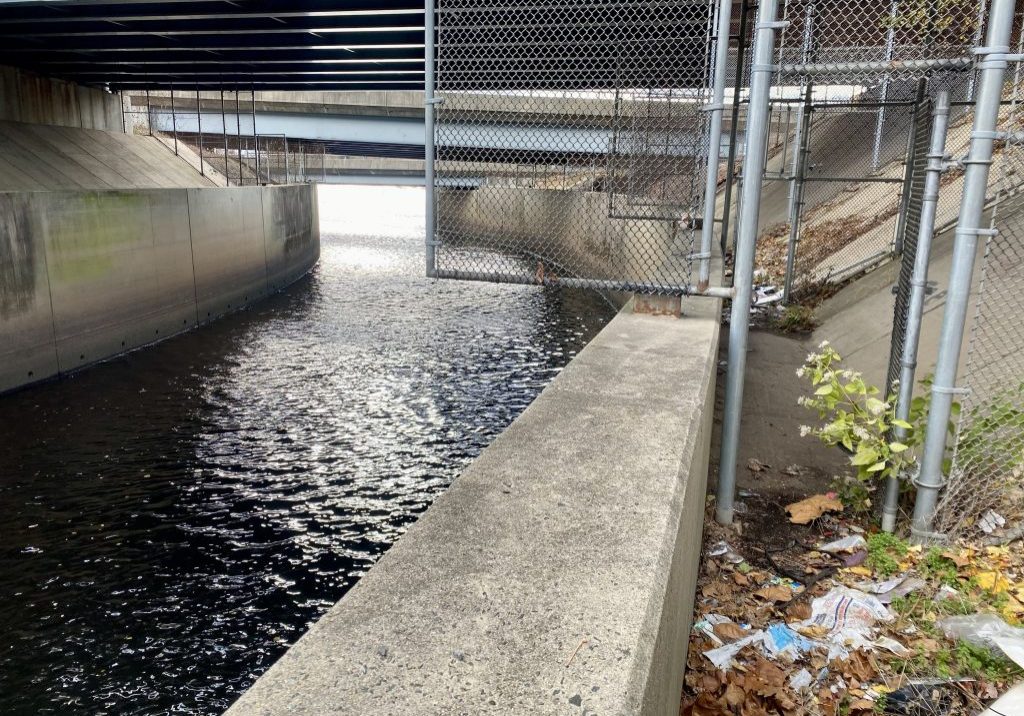
Trenton intends to move that freeway one day, as well as to transform the entire area into a waterfront park. I have faith that this will happen. But if the past is preview, it won’t unfold on anyone’s preferred timescale. In the meantime, I get as close to the creek’s mouth as I can by climbing over a small fence and peering beneath the roof of the freeway. Looming concrete walls are channeling the Assunpink Creek through one last set of human restraints — an intimidatingly large set of chain-metal gates. I can go no further without breaking the law. Yet if I duck and squint, I can just about see the moment when this little creek— carrying everything it picked up on its adventure — becomes one with the Delaware River.

1 Comments
Leave a Comment
Recent Stories


This may be off-topic for this particular piece, but we believe relevant for the Delaware Currents Team in general who have been dedicated to reporting on serious threats to the safety of stakeholders and communities along the rivers.
****************************
Here, as 2025 runs down, the Flood Victims along the Delaware River Basin are looking toward some reassuring conditions:
NOAA long-range forecasting does not indicate abnormally high levels of precipitation for Spring 2026
The Delaware-Sullivan County reservoirs are down–low enough at the moment to provide a large enough “safety void” to protect down-basin stakeholders.
However (as we all know) these conditions could change without warning.
Another positive note comes from the new Congressman, Josh Riley, who represents the region where all of the NYCDEP’s reservoirs are situated: NY’s 19th district. The Congressman assures us the he will be dedicated to protecting his constituents who live in harm’s way along the river.
We’ll see how that goes.
Meanwhile we very much appreciate your coverage of our lives on the East and West Branches and Mainstream Delaware.
Our heartfelt thanks to the Delaware Currents Team and our gratitude for the coverage you may continue in future. We know that journalists like you are our best hope to keep us informed of the good news for–and threats to–the lives and property of all of us who live on The River.