Managing microplastics across the watershed: How water providers are responding to another ‘emerging’ contaminant
| December 15, 2025
As communities grapple with decades of toxic pollution from “forever chemicals,” a group of governors are pushing for federal action on another widespread and unregulated contaminant: microplastics.
The day before Thanksgiving, governors from seven states, including Delaware and New Jersey, announced they were petitioning the U.S. Environmental Protection Agency to start addressing nationwide microplastics contamination. Microplastics are as they sound — mini pieces of plastic, technically anything smaller than 5 millimeters, or about the width of a pencil’s eraser.
“New Jersey is proud to lead six other states at the forefront of an emerging public health and environmental issue that affects all of us,” New Jersey Gov. Phil Murphy said in a statement. “We deserve to better understand the potential for microplastics contamination in our drinking water.”
Murphy and Delaware Gov. Matt Meyer were joined by the governors of Connecticut, Illinois, Maryland, Michigan and Wisconsin in asking the EPA for monitoring of microplastics.
For nearly a decade, researchers across the Delaware River watershed have been working to get a handle on how widespread microplastics are. In many cases, there are still more questions than answers.
Microplastics, like PFAS (aka forever chemicals), are so ubiquitous they’ve been found in Arctic snow, deep-sea trenches and even human blood. Microplastics can be made of different types of plastic polymers, coated or containing even more types of chemicals, and be a variety of shapes and sizes — making setting a standard measurement difficult.
“We’ve all started doing this initial research. We have good baseline data,” said Jacob Bransky, a senior aquatic biologist at the Delaware River Basin Commission. “The next steps might be to all come together and compare results and figure out what those next steps are. I personally don’t have an answer.”
The Delaware River Basin Commission has no immediate plans to update its 2022 report on microplastics across the watershed, but the governors’ recent request of the federal government could mean more support in the future, at least for those states. With no formal regulations or government oversight regarding microplastics contamination, though, it’s difficult for regulators, providers, and groups like the DRBC to justify — and fund — the resources needed to to assess the problem of microplastics.
While that regulatory request plods ahead, progress to address cancer-causing per- and polyfluoroalkyl aka PFAS or “forever chemicals” might lead to upgraded treatment systems that can remove microplastics as well.
“Having treatment in place for PFAS is already going to be one step ahead for treating microplastics in drinking water,” said Sandi Spiegel, chief of health systems protection at the Delaware Division of Public Health. Spiegel said reverse osmosis systems that might already be in place to treat high nitrate levels or other contaminants, for example, can also remove PFAS and microplastics. So, too, can granular activated carbon, one of the most common choices for PFAS removal. But there are limits to their abilities.
“It is going to be challenging,” she said, noting that smaller microplastics might not be captured by carbon and that it may get overloaded with competing contaminants. “Some [microplastics] as small as 1/80,000th of a piece of hair. Trying to detect something that small is going to be difficult.”
Counting the pieces
Measuring microplastics is exactly what University of Delaware’s Jonathan Cohen has been doing for the last decade.
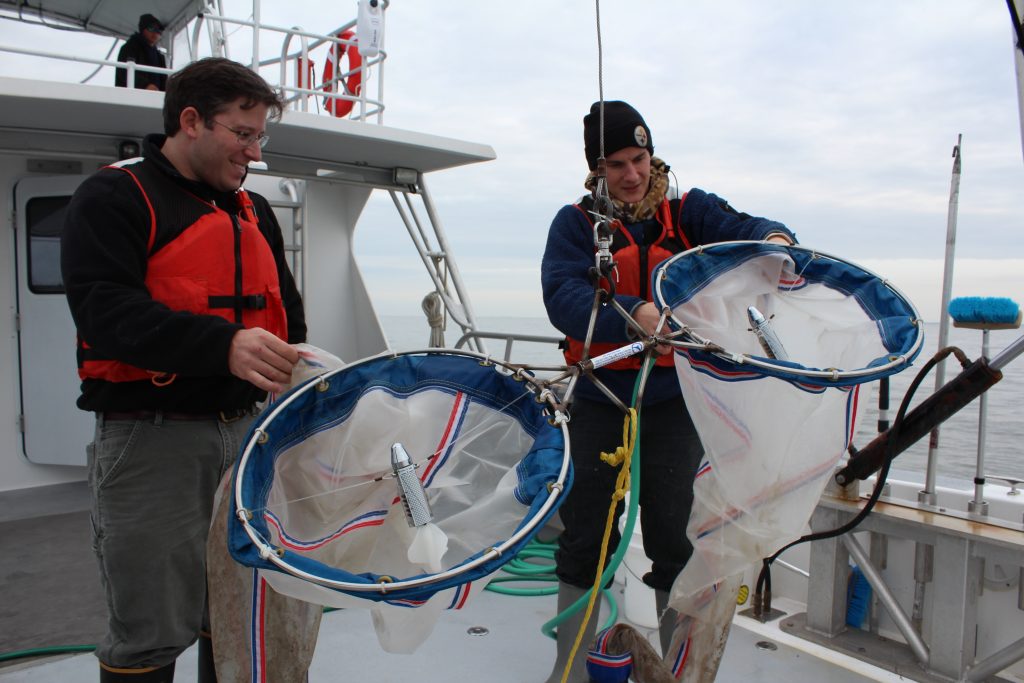
The marine scientist and several student researchers over the years have been analyzing microplastics in the Delaware Bay by collecting samples, developing models and examining aquatic animals. Through this work, he’s explored not only where microplastics are found but what kinds of polymers can be found, how natural forces like tides and currents affect where the contamination congregates, and how microplastics might affect certain organisms like blue crabs.
What he’s found is that microplastics are not just on the surface of the water, but throughout the water column, and organisms like blue crabs are interacting with them.
“The implications of that are less clear,” he said, noting that his team is researching crab larvae outside of state waters to see if they’re interacting with microplastics. (Spoiler alert: They are.) “Yes, there are little baby crabs that have plastic in them,” he said. “Does that affect the population? We don’t know at this point.”
One interesting observation Cohen found in his work with blue crabs in the lab: Larvae that were exposed to microplastics suffered developmental delays. However, once those plastics were removed, they were able to recover and catch up with normal growth patterns.
One theory is that the plastic itself may not be the problem, but that those crab larvae expend energy searching for food, and when they consume non-nutritious microplastics, they waste energy without getting anything in return. More research is needed to explore that connection.
“If you have to wade through a bunch of rocks to get your hamburger, there’s more energy expenditure,” he explained. The situation gets even more complicated in the wild, where complex coastal dynamics that include tides and currents and storms can congregate plastic debris with all the other aquatic debris — tiny organisms included.
Cohen’s work has also found that as fresh water from the Delaware River mixes with the denser saltier water from the Delaware Bay, that mixing area tends to trap a lot of material — microplastics included.
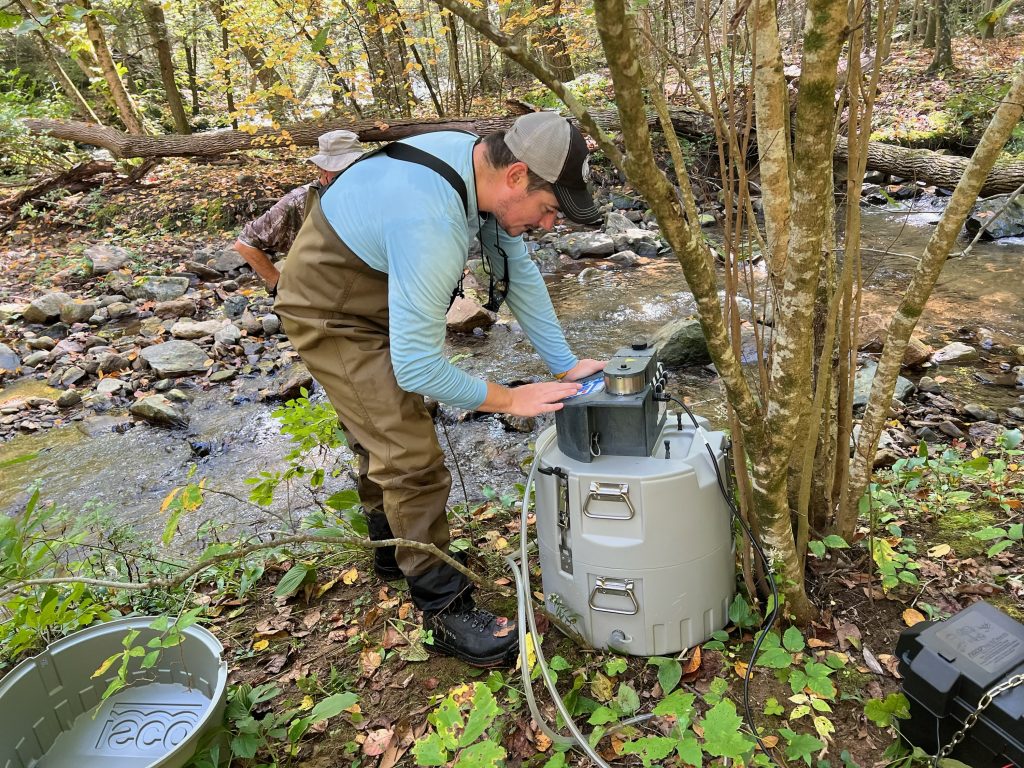
The 2022 watershed-wide report from the DRBC also found some hotspots for microplastics, and raised concerns about the potential negative interactions with wildlife that depend on the waterways. That study found microplastics in nearly every sample taken throughout the watershed, with the highest concentrations of microplastics found in samples taken from Rancocas Creek and the Cooper River.
As long as plastics continue to be produced, microplastics will continue to reach the environment. And projections for plastics continue to rise. Researchers expect global use of plastics to nearly triple from when it first hit the market in the 1950s, to about 1.2 billion metric tons a year by 2060, according to a review study published in The Lancet this fall.
Microplastics and nanoplastics are created from the eventual breakdown of plastic bottles and packaging, toys and automobiles, synthetic clothes and fishing gear, and basically every modern-day plastic-based item you can think of.
The tide lines in the lower Delaware River that congregate plastics along with other debris can actually be seen from space, Cohen said. “The dynamics are pretty complex in terms of how the material gets in,” he explained. “It’s literally coming from everywhere.”
Co-mingling contaminants
At the City of Philadelphia’s treatment plant, like all others across the country, a key obstacle to addressing microplastics is that they’re not considered a “regulated contaminant,” meaning there’s no federal or state law governing microplastics contamination to protect human health.
“Whenever anybody brings up microplastics,” said City of Philadelphia Watershed Protection Program Manager Matt Fritch, “we tell them we have to take care of the macroplastics first.”
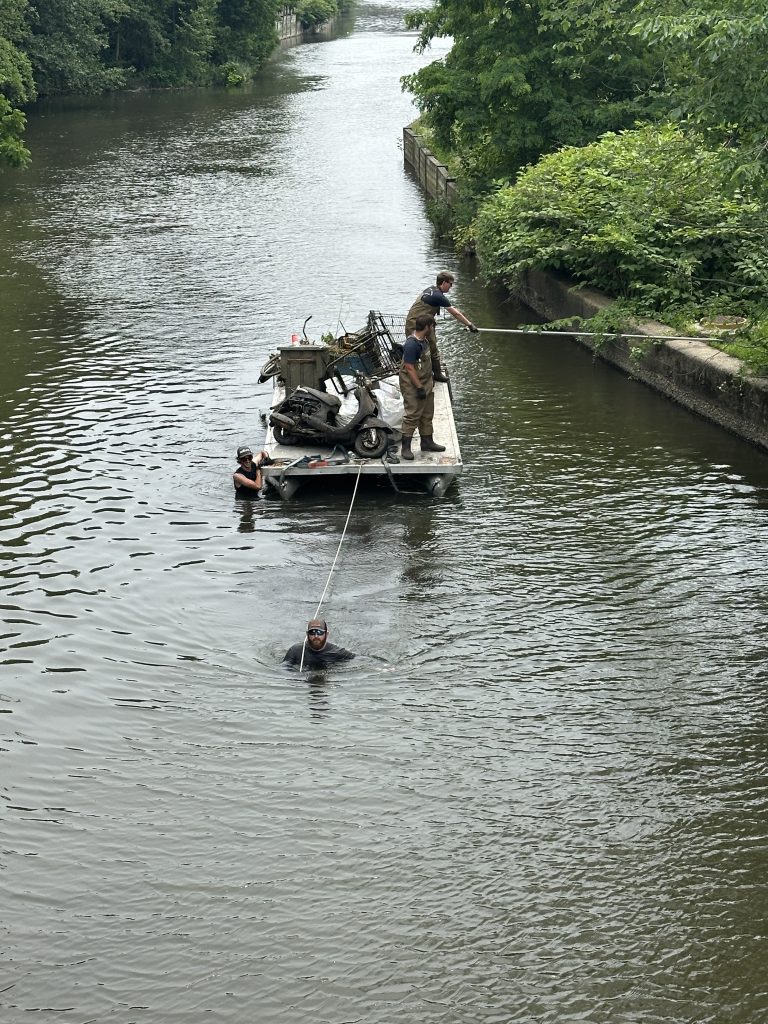
That’s one of the reasons why the city has a new contract with the Philadelphia Barge Company to deploy skimming vessels to remove full-sized plastics and litter from waterways. Each year on average, the skimming vessels collect about two tons of plastic from the Delaware and Schuylkill Rivers. About 60 percent of that recyclable waste collected was single-use plastic bottles.
“Bottled water is not a good answer to this,” Fritch added. Studies have shown that microplastics can be found in all sorts of food products, with some research indicating that microplastics may get into bottled beverages when the plastic caps are snapped open.
Scientists have also warned that the tiniest of microplastics, also known as nanoplastics, pose the greatest public health risk because they’re more able to fit into smaller spaces, like across cell membranes.
At the city’s drinking water and wastewater treatment plants, most microplastics are already filtered out during traditional treatment processes — with the exception of the tiniest nanoplastics. Studies have estimated that up to 55 percent of microplastics are removed during drinking water treatment, while other researchers have found that wastewater treatment methods can remove an average of 88 percent of microplastics from raw sewage.
Even after Andy Kricun retired as executive director and chief engineer of Camden County’s wastewater treatment facilities in 2020 after more than two decades in the field, microplastics are still on his mind. As an active member of Jersey Water Works and as a volunteer on the advisory Environmental Justice Advisory Council through the NJ Department of Environmental Protection, Kricun and others believe that, like addressing PFAS, there needs to be a comprehensive approach to microplastics pollution that starts with reducing production in the first place.
“The first goal would be to reduce the creation of new ones,” he said. It’s also about doing what’s already being done, but better, Kricun said, noting that optimizing wastewater treatment plants could be considered “low-hanging fruit” in addressing the problem.
Finding solutions from pipeline to plumbing
Understanding and addressing the sources of plastic pollution to begin with is key to solving the problem downstream, regulators like Fritch and Spiegel said.
“Our best advice right now for folks is to figure out how to understand where they’re coming from and break down those pathways,” Spiegel said. “When it comes to treatment for microplastics, again, we’re still learning.”
By starting with understanding how microplastics can potentially affect people’s health — through inhalation, ingestion, and absorption — there are a few simple changes people can make to reduce exposure, Spiegel said.
Taking off your shoes at home, “wet” dusting to clean microplastic-laden dust particles, avoiding plastic products and containers by switching to glass, wood, or metal, and purchasing fewer synthetic clothing items and textiles can all reduce everyday indoor plastic exposure, she said. Avoid personal care products that might contain microplastics. Consider adding filters to household plumbing systems, sinks, or even washing machine drains.
“There’s so many different choices you can make to minimize adding these emerging contaminants into the drinking water system,” Spiegel said.
Since 1995, synthetics have made up more threads of clothes made than typical textile fabrics like cotton once did. Researchers have found that most of the outfits people wear today are plastic. Production of synthetic fabrics, as well as laundering those clothes, are also key contributors to microplastics pollution.
Local efforts like a bill introduced last year in New Jersey that would require additional filters on washing machines to capture microplastics could help, too, as can state-specific bans on plastic bags and other plastic products like polystyrene containers.
“There’s a range of options between doing nothing or doing everything. Doing everything is daunting, it’s overwhelming,” said Kricun, who now works for the nonprofit water services utility advisory group Moonshot Missions. “I think what’s really needed is, because each of the components of the solutions requires a different kind of action — legislative, regulatory, consumer education, wastewater treatment, drinking water treatment — there ought to be some sort of entity or task force designated to generate a program to reduce the impacts of microplastics on public health and the environment.”
Until that “moonshot” effort to address microplastics does happen, and barring any new efforts to set state-specific standards or rules regarding microplastics production or treatment, the next-best regulatory solution could come at the end of 2026 if microplastics are added to the new round of unregulated contaminants monitoring as requested by those seven governors.

Recent Stories